
Your IELTS institute needs to manage four sections, each with a different teaching process. Students listen to recordings, work through passages, submit essays and practise speaking. Teachers need to see that work, respond to it and decide what each student should practise next.
IELTS coaching app development should connect those activities in one place. Your institute should be able to create courses, manage its content, run mock tests and organise feedback. Optional AI assistance can support practice between classes, while teachers stay in control of reviewed assessments.
If you offer individual mentoring, include that in the plan too. Session bookings, teaching records and each mentor’s session-based salary calculation belong in the requirements from the start.
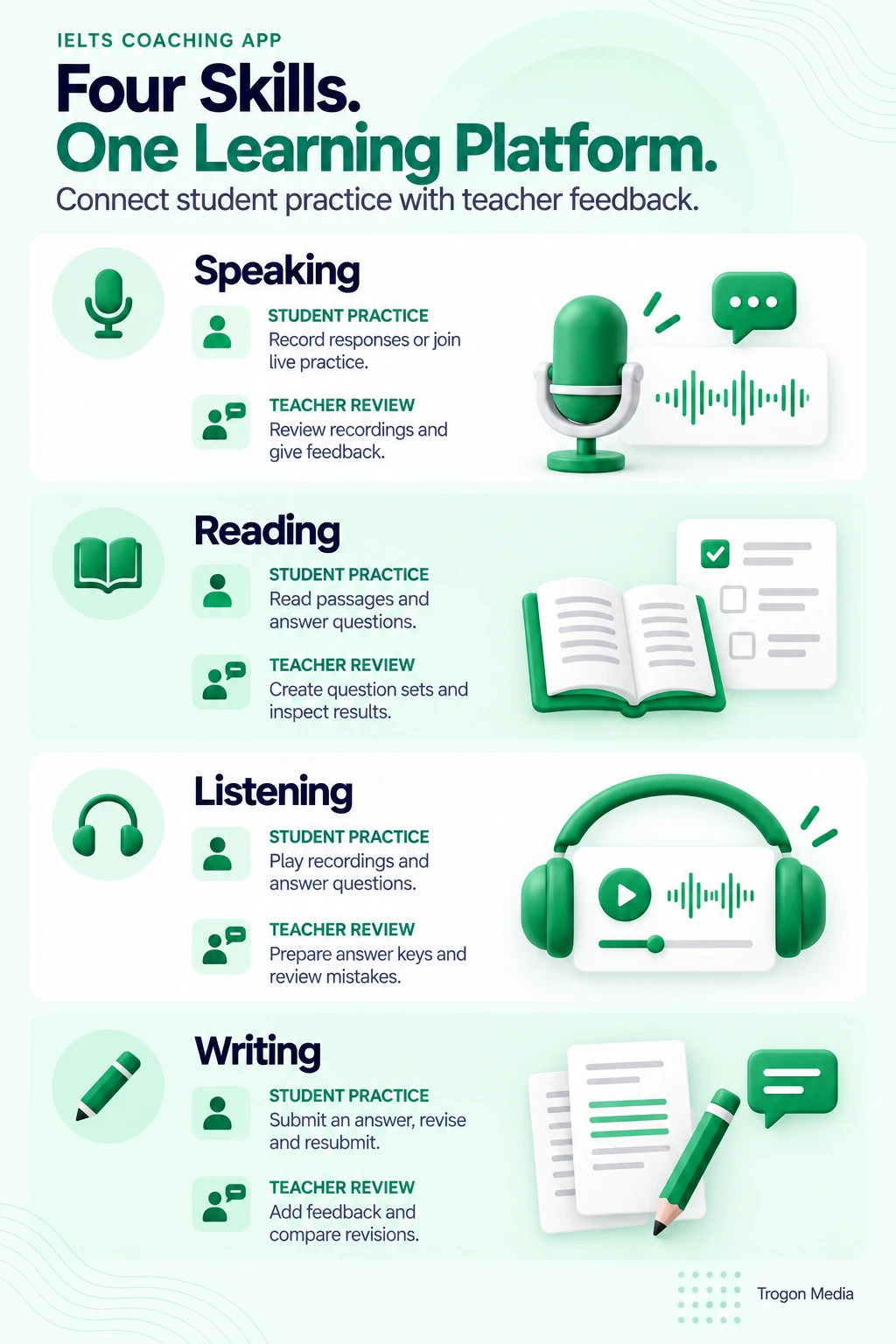
Manage all four IELTS sections in one app
Start with how your teachers work. For each section, specify what students receive, what they submit and how teachers review it.
| Section | Student activity | What to specify for teachers |
|---|---|---|
| Listening | Play recordings and answer linked questions | Upload audio, prepare answer keys and review mistakes |
| Reading | Read passages and complete question sets | Create passages, configure question types and inspect results |
| Writing | Respond to a task and submit an answer | Review submissions, add feedback and compare revisions |
| Speaking | Record responses or attend practice sessions | Assign prompts, review recordings and record feedback |
Your institute should control course creation and content management. A teacher might add a Writing lesson to an existing course, while an administrator creates a separate revision programme with its own enrolments.
Agree who can publish changes. You may want teachers to prepare material and a course coordinator to approve it before students see it.
Content also needs the right labels. IELTS Academic and General Training share Listening and Speaking tests, but their Reading and Writing tests differ. Keep those distinctions clear in the course library and student assignments.
Choose a sample lesson from each section before requesting a development quote. They show the developer how your teachers organise material, what students must do with it and which parts need to be interactive. A PDF upload, an interactive passage and a timed recording task require different work.
Build IELTS mock tests around your course content
A full mock and a short practice exercise serve different purposes. Your app requirements should describe both. Our online exam and test-series software guide explains how question banks, scoring and review rules fit together.
For example, a Listening exercise could allow replay and show explanations after submission. A timed mock could follow your selected test format, with different playback controls and a defined results-release policy.
Make those rules explicit. Decide:
- Which question types your teachers need to create.
- How time limits, audio playback and submission work.
- How answer keys handle accepted alternatives.
- What happens if a connection drops during an attempt.
- Whether results appear immediately or after teacher review.
Test the rules with actual sample content. Ask a teacher to complete an attempt, review the result and correct an answer key before launch.
For computer-based preparation, include a desktop or laptop test experience in your scope. Daily phone practice can use a different layout. A student reading a passage beside its questions has different screen needs from someone recording a short speaking response.
Use our LMS mobile app versus web app guide to compare those options.
An institute that needs a ready-made test library with standard workflows may be well served by an existing platform. A custom build becomes useful when you need control over your content, teaching process and connected administration. Budget time for preparing that content alongside development.
Support recorded, live and AI-assisted speaking practice
Define what speaking practice means. An audio submission, a live interview and an AI conversation each need their own recording, scheduling or feedback workflow in your app brief.
Recorded practice lets a teacher assign a prompt and review the response later. Specify the preparation time, recording limit, permitted retakes and how students submit their chosen attempt.
Let students check the audio before submitting. Decide how an interrupted upload resumes and how staff identify submissions waiting for review.
Live practice connects a student with a teacher at an agreed time. Define booking availability, reminders, attendance and where the teacher records feedback afterward. Our live-class integration guide covers the connection between scheduled sessions and your LMS.
The official IELTS Speaking test has three parts and lasts 11–14 minutes. It is an interview assessed by an examiner. A recorded exercise can practise part of that process; a live mock can rehearse the interaction.
AI-assisted practice can be scoped for conversations between lessons, suggested follow-up prompts and preliminary feedback. Teachers should be able to review the outputs used in their coaching. See our AI mentor guide for planning access, usage and teacher oversight.
Label automated band estimates clearly. Students need to know whether they are reading an AI suggestion or a teacher-reviewed assessment; practice scores are estimates, not official IELTS results.
Trogon Media has delivered multiple IELTS learning platforms, with support for recorded, live and AI-based speaking practice. Our custom LMS development work is scoped around the teaching process each institute needs.
Connect teacher feedback to the next attempt
A score gives the student a result. The feedback workflow should explain what needs attention and give the student a clear way to practise it again.
A useful starting process is:
- Assign the submission to a teacher.
- Show it in the teacher’s review queue.
- Add feedback against the relevant assessment criteria.
- Publish the reviewed feedback to the student.
- Request a revision or another practice attempt.
- Keep both attempts available for comparison.
Adjust this process to your institute. You might allocate work by batch, by section or to each student’s assigned mentor. Some submissions may need a second review before publication.
For Writing, use the official IELTS assessment criteria to inform how your teachers organise feedback. The interface should let them explain their assessment and identify something specific to practise next.
Consider this illustrative workflow. A student submits an essay. The teacher identifies an unsupported argument, comments on the relevant paragraph and asks for a revision. The student revises and resubmits.
Keep the original attached to the task so the teacher can compare attempts and see whether the student applied the feedback. A mentor can use that history during the next session.
AI assistance can support a first pass or suggest areas to inspect. Give the teacher a way to accept, edit or reject that draft feedback before presenting it as reviewed.
Make the review queue useful first. Staff need to see who owns a submission, when feedback is due and which students are waiting.
Manage one-to-one mentoring and session-based salaries
Individual mentoring adds another set of requirements. A student may attend batch classes and also have a package of private sessions with an assigned teacher. Our one-to-one tutoring LMS guide explains how bookings, session allowances and personal learning plans can work together.
Keep those sessions connected to the learning record. For example, a mentor preparing for a Writing session could review the student’s latest submission and the previous teacher’s comments.
For this build, define the session record carefully: student, mentor, date, duration, status and any completion approval your institute requires. Then decide which records count towards the mentor’s salary.
A booking alone should not determine what a mentor is owed. Your calculation must follow your institute’s agreed session rules.
| Decision | Rule to agree before development |
|---|---|
| Mentor rate | Fixed amount per session, hourly rate or another agreed basis |
| Session length | Whether different durations have different rates |
| Completion | Who confirms that the session took place |
| Cancellations | Which cancellations or missed appointments are payable |
| Rescheduling | How a moved booking stays linked to the original session |
| Corrections | Who can amend an approved record and how changes are recorded |
Here is a hypothetical calculation. A mentor has 14 bookings in a month: 12 approved completed sessions and two cancellations. At an illustrative rate of ₹400 per completed session, with cancellations unpaid, the session-based amount is 12 × ₹400 = ₹4,800.
Use your own rates and policy. The institute must decide which sessions qualify, who approves them and how their value is calculated before the developer configures the report.
Our builds support individual mentoring management and salary calculations based on sessions, with approval steps and calculation rules customised to the client’s requirements.
Ask for a statement showing the sessions behind each amount, so staff can check it before payment. Scope payment processing separately if you also need it.
Scope the first version and its operating costs
Price the workflows you need to run at launch. A build brief should identify the four section workflows, required question formats, feedback process, mentoring rules and selected AI functions.
Then separate launch requirements from later additions. Use our custom LMS development timeline to plan requirements, testing and staff training. If teachers already run effective live speaking sessions, the first release might prioritise booking, attendance and feedback records. AI conversation practice could follow once the core process works.
As of September 2026, Trogon custom LMS builds start at ₹3 lakh, with the quote increasing according to requirements. This is a starting point for custom LMS work, not a fixed price for every IELTS feature described here.
Our custom LMS development cost guide explains the broader budgeting decisions.
There is no LMS licence fee, per-student fee or commission taken by Trogon on student payments. Recurring infrastructure costs still apply through the AMC: servers, video hosting, storage, live-class services and OTP usage.
AI usage also needs a budget. Describe the expected activity: speaking-practice minutes, writing submissions and how often students can request feedback.
More audio, storage and AI usage can increase operating costs. Ask for the assumptions behind the estimate, plus clarity on included support and how later feature changes are quoted.
Settle these requirements before development
Bring a small set of real teaching materials to the requirements discussion. Include a Listening recording with questions, a Reading passage, a Writing task and a Speaking prompt.
Add your mentoring salary rules. A sample feedback report will also show the developer what students should receive after a teacher has reviewed their work.
Before accepting the build, walk through a complete student journey. Create a course, enrol a student, submit work, review feedback and book a mentoring session. Then inspect the mentor’s salary statement.
Include an interrupted upload and a cancelled booking in that walkthrough, and agree how the app should handle each before students depend on it.
Share how you run your IELTS courses, review student work and pay mentors per session. We’ll use those requirements to scope your app.
Plan your IELTS coaching app
Build your IELTS coaching app with Trogon
Share your course content, teacher-feedback process and mentoring rules. We’ll use those requirements to scope your app.
Connect on WhatsApp