
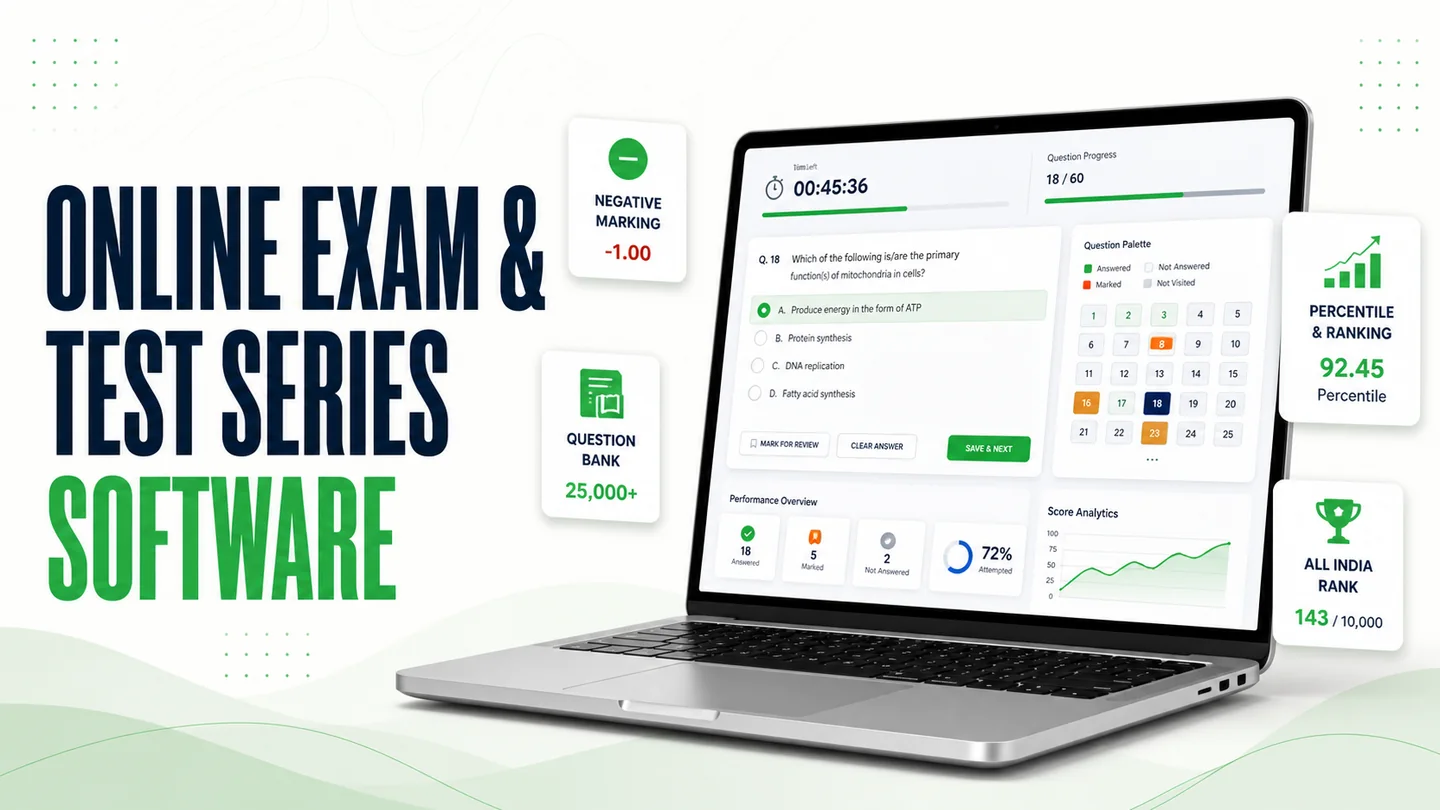
Say your coaching centre sells a test series to 1,800 students. The platform takes a cut of every rupee they pay. And the percentile each student sees at the end is calculated against strangers, not against your batch. Both of those trace back to one decision made much earlier: where the assessment runs.
Most online exam and test series software for institutes is sold as a single feature. It isn't one. An exam is graded once and becomes a permanent record. A test series is attempted many times and is often a product you sell. They need different rules, different data, and different maths. Where you run them decides three things: who owns your question bank, whether your rank means anything, and who touches the money students pay you.
An Exam and a Test Series Aren't the Same Thing
| Factor | Online exam | Test series |
|---|---|---|
| Attempts | Once, usually supervised | Many, on the student's own time |
| Purpose | Produce a record | Produce improvement |
| Grading | Final, feeds the report card | Instant, feeds the next attempt |
| Comparison | Against a passing mark | Against everyone else who attempted |
| Money | Included in fees | Often sold on its own |
| What breaks it | A disputed mark | A meaningless percentile |
The test series side has actual evidence behind it, which is rare in this category. In a study published in Psychological Science, Roediger and Karpicke found that students who were tested on material retained substantially more of it a week later than students who simply restudied it the same number of times.
There's a catch worth knowing. On a test five minutes after studying, restudying won. Testing only pulled ahead at two days and one week. So a test series that runs the week before the exam is doing something different from one that runs all year, and the second one is where the benefit sits.
Three Exam Patterns, Three Completely Different Scoring Rules
Competitive pattern. JEE, NEET, CAT, UPSC, SSC, CUET. Negative marking, and the rate is often different from section to section. An unattempted question and a wrong question are not the same event and can't be stored as the same value. Multi-select questions may carry partial credit. Sectional cutoffs mean a student can clear the total and still fail. Then rank and percentile are computed across the whole cohort, which means the scoring can't finish until every attempt is in.
University semester pattern. Internal marks and external marks kept apart, then combined with a weightage that the department sets and changes. Grace marks. Supplementary attempts that replace a mark without erasing the history of it. Credit-weighted grade points rolling into a CGPA that has to survive a student changing electives.
School pattern. Unit tests and term exams with different weights, scholastic marks separated from co-scholastic ones, and everything landing in a report card a parent will read and question.
Now put those side by side. The competitive pattern needs a scoring engine that can hold a negative value and a null and tell them apart. The university pattern needs mark history, because a supplementary attempt has to be auditable years later. The school pattern needs the mark to leave the exam module entirely and arrive somewhere a parent can see it.
Very little software does all three, because most of it was built for one and then stretched. That's usually what an institution runs into: not a missing feature, but a scoring rule the system has no way to express and a vendor roadmap you don't control.
For Kerala PSC, our PSC coaching app guide applies those rules to daily practice, past papers, timed mocks and mistake revision.
I looked at every page currently ranking for this topic. Not one of them mentions negative marking.
Your Question Bank Is the Asset
Everything else in an assessment system can be rebuilt in a month. A question bank takes years, because it's your faculty's time.
A bank is worth something only if every question carries metadata: a difficulty value, a topic tag, a subject, and the history of how students have actually performed on it. With that, you assemble a paper from a blueprint. Ask for twelve questions at difficulty three and four from two chapters, and the system builds it. Without it, a teacher picks questions by hand every single time, which is the thing you bought software to stop doing.
ePravesh describes a sensible progression: foundation tests at difficulty one and two, then topic tests, then multi-topic mocks, then full-pattern papers at difficulty three to five.
If you leave, what comes with you? Ask for a sample export before you sign anything, not after.
Questions usually come out. The difficulty calibration, the per-question performance history, and the media attached to each question often don't.
Use the question-bank migration checks to test a representative export before agreeing what the new system will preserve.
What Happens After the Student Hits Submit
Objective questions grade themselves, and that's the easy part everybody demonstrates.
The rest is where systems quietly fall short. Descriptive answers need a teacher marking queue, with the ability to hand out partial marks, leave a comment, and have a second examiner review a disputed script. Students who work on paper need to photograph their answers and upload them. Practical and interactive questions need to record what the student did, not only what they finally selected.
We build all of these types, including interactive ones, into the systems we deliver. Whether an institute needs them varies more than you'd expect. Plenty run entirely on objective questions and are right to.
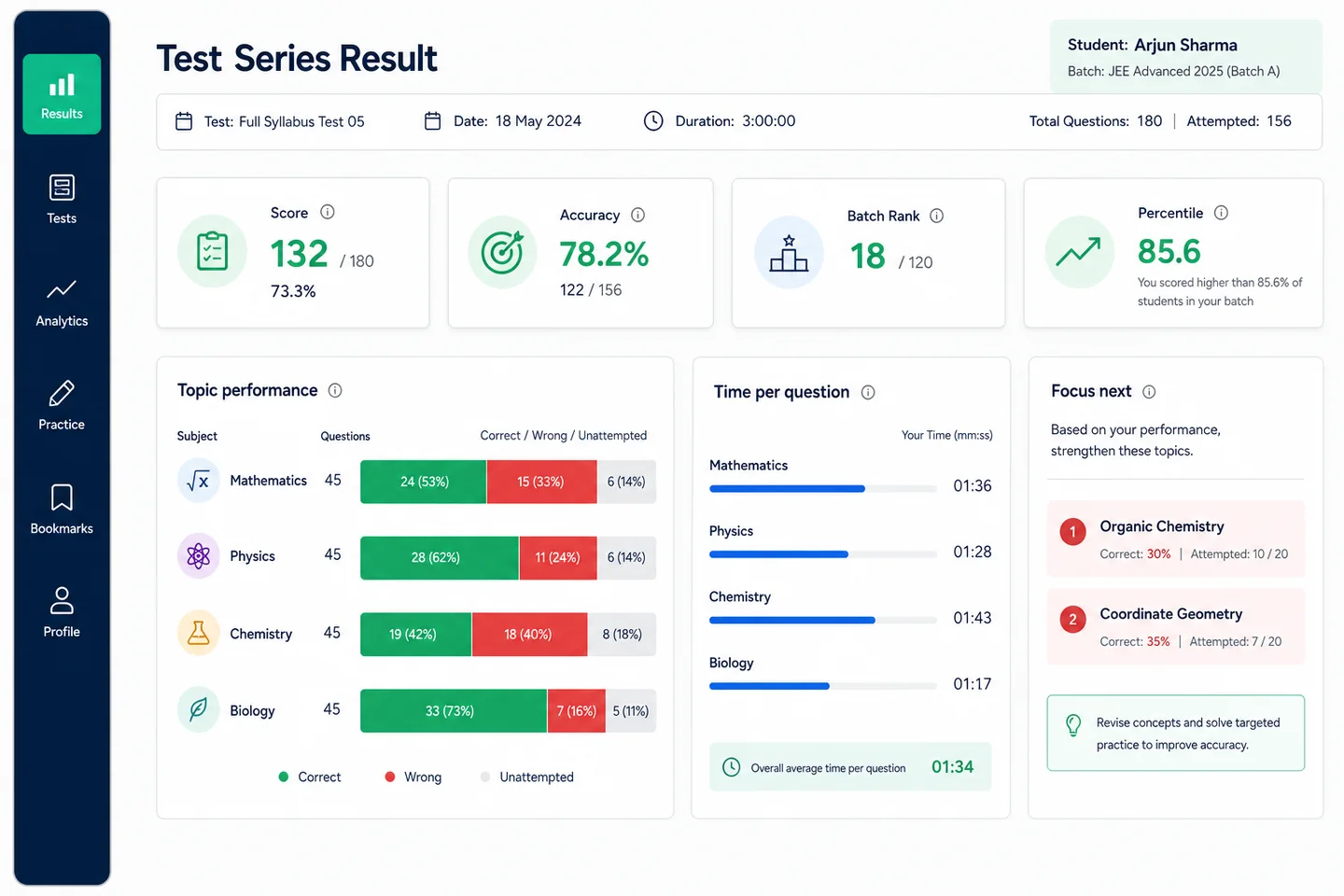
Then the mark has to travel. In Ecopen, the school ERP we built, an exam result feeds instant progress reports and report cards in both text and graph form, and the exam schedule sits with attendance and fee records instead of in a separate tool. That connection is the whole reason to keep assessment inside the system that already holds your students. When the mark lives somewhere else, somebody types it in twice, and the second copy is the one that's wrong.
If you want to add guided revision after an attempt, our AI mentor guide to practice quizzes and follow-up learning explains how to connect a student’s doubts to course material and faculty support.
A Percentile Is Only Real If Every Attempt Is in One Place
Rank is a comparison, so it inherits whatever group you compare against.
Run your test series on a shared platform and the percentile a student sees may be computed against that platform's users. Some of them are preparing for a different exam. Some attempted the paper three months ago. The number looks precise and means very little.
Run it inside your own system and the comparison group is your batch, on your schedule, sitting your paper. A student who ranks 40th out of 300 in your Kozhikode centre learns something they can act on. A student who ranks in the 62nd percentile of an unknown national pool has been given a decoration.
This is also why cohort ranking is hard to bolt on later. The maths needs every attempt, which means it needs one system.
What It Actually Costs You to Sell a Test Series
Here's what makes test series different from every other thing in your system: it's the one you sell directly to students.
That changes the arithmetic completely. A monthly subscription is overhead, and overhead is annoying. A commission on test series sales is a tax on revenue, and it grows exactly when you succeed. Sell 1,800 seats instead of 400 and the cut grows with you, for work the platform did once.
Something I noticed while researching this piece: the pages across this category that invite you to sell your test series describe the features at length, and none of the ones I opened put the commission on that page. It's always somewhere else. That's a choice about where a number goes, and it tells you which number the reader is expected to focus on.
Our position is written into the contract. No licence fee, no per-student fee, and no commission on student payments. You pick your own payment gateway, or your bank's, or none, and we're not in that chain at all. If 1,800 students pay you for a test series, you receive what 1,800 students paid.
Now the part that has to be said in the same breath. You still pay an annual maintenance charge, and it's pass-through infrastructure: servers, video hosting, storage, live-class platform, OTP charges. Those cost money for anyone running this, including us. What you don't pay is a licence that charges more because you enrolled more students, or a share of fees you already collected.
Work out whether this holds for you
Take your current platform's terms and calculate the cut on one test series at the volume you're actually planning. Then compare that to a fixed build cost. If the answer favours staying, stay. Send us your numbers on WhatsApp at +91 96051 31100 and we'll do that comparison with you, including the cases where it doesn't come out in our favour.
Exam Day Is a Spike, Not a Load
Assessment breaks differently from the rest of an LMS, and understanding why is worth more than any vendor's scalability page.
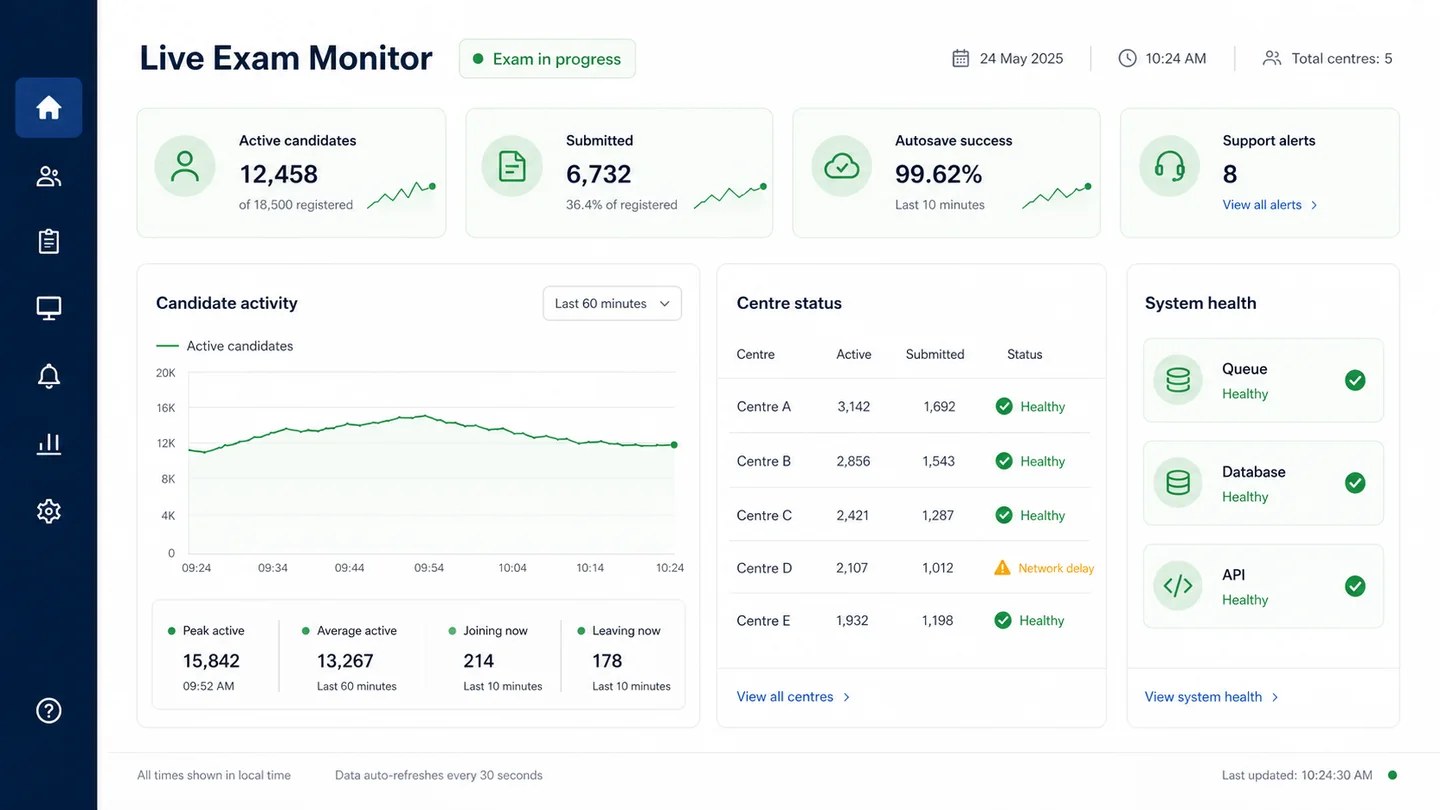
Ordinary LMS traffic is mostly reads. Students open a video, download a PDF, check a timetable. Exam traffic is writes. Every candidate's answers autosave every few seconds for the length of the paper, all of them starting within the same two minutes. If 50,000 candidates autosave once every 30 seconds, that's roughly 1,700 database writes a second, sustained for three hours. Bigger servers don't fix that on their own. It needs the write path designed for it: queued submissions, session storage in memory rather than on disk, connection pooling, and an application layer that holds no state so you can add more of it.
We've supported an exam programme serving more than 50,000 students on a single client's system. Capacity still has to be tested against the actual sitting pattern—one simultaneous cohort and several scheduled shifts create very different infrastructure demands.
Numbers like this are only meaningful with the conditions attached, so ask any vendor quoting one what the paper was, how long it ran, and whether the figure was concurrent or spread across shifts. The cheapest scaling lever isn't infrastructure at all. It's scheduling. India's largest computer-based exams run across hundreds of centres in shifts rather than putting every candidate on at once, because splitting the sitting is far less expensive than surviving it.
When a Separate Exam Tool Is the Better Answer
Three cases where we'd tell you not to build:
- You need heavy invigilation. Webcam monitoring, identity verification, and AI flagging are the core of what you're buying. Dedicated proctoring products have spent years on that specific problem and integrate with most systems.
- You run assessments occasionally. A handful of exams each year on patterns that never change makes a subscription tool cheaper, and you'll be running next week.
- You need to be live in days. A custom build takes about 30 days end to end, and no amount of wanting it changes that.
If none of those describe you, and you've been fighting a scoring rule your platform can't express, the calculation is different. That's the pattern we see most often, and it's covered in more depth in our comparison of custom, white-label, and pre-built systems.
Questions Institutes Ask Us
Can an online exam system handle negative marking and sectional cutoffs?
It can if it was built to. The requirement is that the system stores a wrong answer and an unattempted answer as different things, applies a negative rate that can vary by section, and evaluates sectional cutoffs before deciding a pass. Ask for a sample scored result with a section a candidate failed while clearing the total.
Can we sell a test series and keep the full amount?
That depends on your platform's terms, not on the technology. On a system you own, students pay through your gateway and the money is yours. Read your current agreement for the words “commission,” “transaction fee,” and “revenue share” before assuming.
Can we move our existing question bank across?
Usually the questions move. What often doesn't is difficulty calibration, per-question performance history, and attached images or media. Ask your current provider for a full export first, and check what's actually in the file.
How many students can sit an exam at the same time?
More than most institutions need, if the write path was designed for it. The number a vendor quotes matters less than the conditions behind it. Ask what paper, how long, and whether it was concurrent or run in shifts.
The Decision Underneath All of This
The question isn't which exam tool is best. It's whether assessment is a part of your system or a tenant in somebody else's—because that answer decides who holds your question bank, whose students your ranks compare against, and who takes a share when a student pays you for practice.
We build custom learning systems that run quizzes, practice tests, exams, and test series, free or paid, on the scoring rules your institution actually uses. Builds start at ₹3 lakh and take about 30 days end to end.
Bring us the difficult rule
Tell Us What Your Current Exam System Can't Handle
Share the scoring pattern, batch size, and payment flow you need. If a subscription tool fits you better, we'll say so.
Connect on WhatsApp