
Your exam starts at a fixed time. Students sign in together, open their questions and begin saving answers. Near the deadline, submissions arrive in a rush. Your backend has to preserve each attempt while teachers and administrators continue using the platform.
For institutions choosing the best backend for LMS development, we recommend Laravel as the core application, with Python for specialized AI services and Node.js for selected real-time requirements.
That recommendation comes from how we build LMS platforms: Redis caching, database optimization, Laravel queues and jobs, and load balancing. Each addresses a different source of pressure. Together, they give the development team practical ways to improve performance and add capacity.
The useful comparison is how each technology fits your learning operation. A framework name alone cannot tell you whether exam answers will save reliably or a payment will activate the correct course.
What your LMS backend needs to manage
Students see courses, lessons and test screens. Behind those screens, the backend shared by web and mobile apps decides what they can access and records what they do.
Consider a student buying a course in instalments. The application must connect payment status, enrolment, the agreed student-access rules and the student’s account. A teacher reviewing an assignment needs permission to see the correct submission. An administrator changing a batch needs that change reflected wherever it affects teaching.
These connected rules are why we give the core LMS application a clear owner in the architecture.
Laravel is a PHP framework. Python is a programming language used with frameworks and other tools. Node.js runs JavaScript on the server. Although they sit at different technical levels, buyers often encounter them as competing backend proposals.
Our recommended division of responsibilities looks like this:
| Technology | Recommended role | What should justify the choice |
|---|---|---|
| Laravel | Core LMS: accounts, permissions, courses, fees, exams and learning records | A team that can build, test and maintain the institution’s connected workflows |
| Python service | Specialized AI processing or model-related work | A defined task that benefits from Python tools or separate computing resources |
| Node.js service | Selected chat, presence or live-update features | A clear requirement for a separately operated real-time service |
This is a proposed architecture, not a requirement to deploy all three technologies from the first release.
Why we recommend Laravel for LMS performance and scalability
Our preference for Laravel is grounded in the work around the learning platform: managing application rules, reducing repeated processing and moving suitable tasks away from requests students are waiting on.
Performance and scalability are related, but different. Performance concerns how quickly an action completes. Scalability concerns how the system continues working as demand grows and resources are added.
We use several techniques together because each solves a different problem. These approaches are also available in other backend ecosystems. Our case for Laravel rests on its supporting tools and our experience operating them together for LMS workloads.
Redis caching reduces repeated work.
Some information gets requested repeatedly without changing each time. Course details and published lesson lists are possible examples. A cache keeps a reusable copy so the application can avoid rebuilding the same response on every request.
Laravel supports Redis through its cache system, giving developers a consistent way to store and retrieve cached values.
The important decision is what to cache and when to refresh it. If a teacher changes course content, the application must update the relevant cached information. Any cached response must also respect differences between institutions and student permissions.
For an LMS, we recommend treating access changes carefully. A fast response showing outdated access rights is still an incorrect response.
Database optimization reduces the work behind each screen.
Suppose an administrator opens a batch report. The application might need enrolments, attendance and exam results. We recommend checking the queries behind that screen before increasing server capacity.
Does the page request every historical record? Does it repeat the same lookup for each student? Are commonly searched fields indexed appropriately?
These questions belong in the development review. Our use of database optimization alongside Laravel reflects a simple principle: avoid making the infrastructure repeatedly perform unnecessary work.
Queued jobs move suitable processing into the background.
A student submitting an assessment shouldn’t have to wait for a large report export or an email delivery attempt. Those activities can be designed as separate jobs, processed by background workers.
Laravel’s queue system supports background processing, retries and failed-job handling. Workers must be running and monitored for those jobs to progress.
For an LMS, we recommend setting priorities deliberately. Urgent learning operations should receive the resources they need even while administrators generate reports. Tasks that may run again must also avoid creating duplicate records or sending unintended duplicate notifications.
Load balancing distributes incoming traffic.
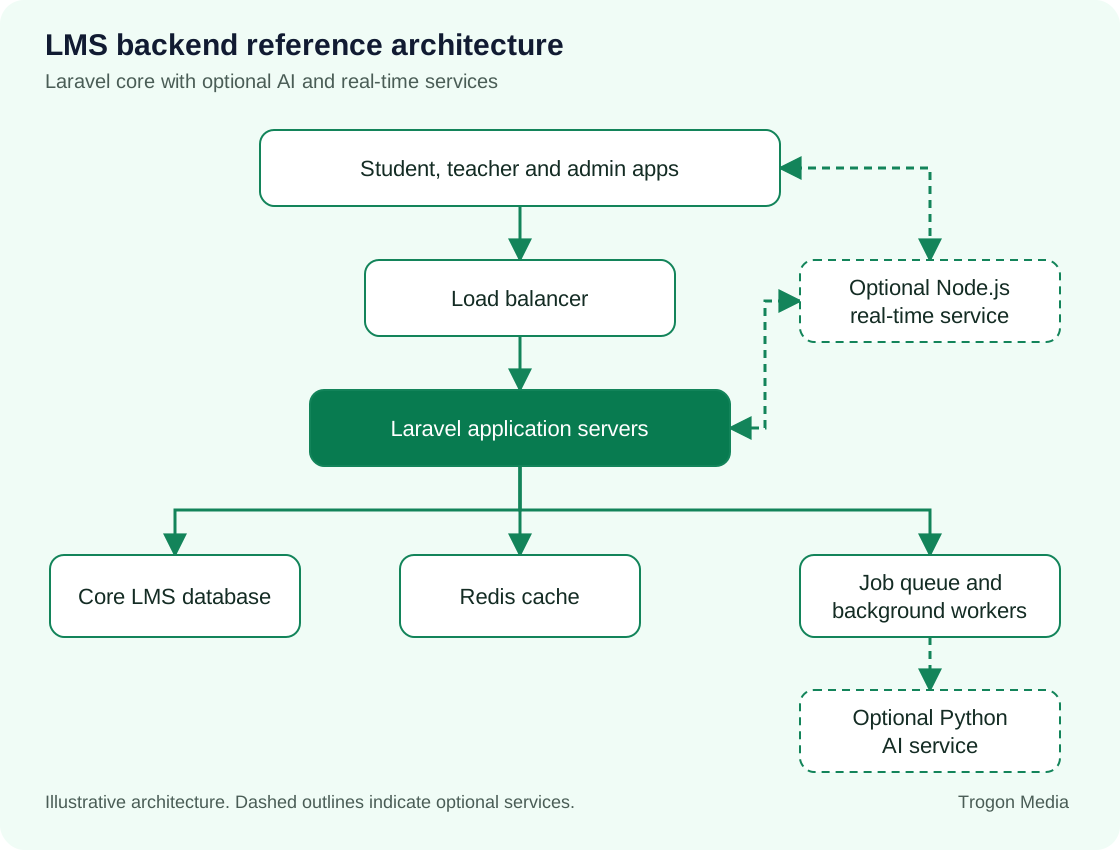
Load balancing lets requests reach multiple application servers. For our reference design, those servers should use consistent application code and shared services where needed, including centrally accessible session data and uploaded files.
Adding application servers is only one part of capacity planning. The database, background workers and external services still need their own review. We recommend measuring where requests spend time before deciding which component needs more capacity.
For the broader planning questions, see our guide to LMS scalability and daily users.
How a Laravel LMS should handle exam traffic
The following is an illustrative design walkthrough, rather than a benchmark or a claim about a particular client deployment.
Start with the exam’s busiest moments: opening time, repeated answer saves and the submission deadline. Test those actions together under the expected load.
We would assess the flow in this order:
- Validate the student’s identity, exam access and attempt status.
- Deliver the correct questions without exposing answer keys or another student’s paper.
- Save answers durably before confirming that a save succeeded.
- Finalize the attempt with controls for repeated or overlapping submission requests.
- Schedule suitable grading, reporting and notification work after the submission is recorded.
- Monitor failures and delays throughout the attempt, including retries after connection problems.
Caching might help with reusable exam information. It needs careful boundaries around randomized papers, personal attempts and changes to published questions. Student answers should have a durable record with an explicit recovery strategy.
The visible messages matter too. “Answer saved,” “submission received” and “result ready” describe different states. The interface should only confirm the state the backend has actually reached.
Laravel supports dispatching queued work after a database transaction commits. That gives developers a way to prevent a follow-up job from running before the records it needs are available. The full submission and recovery workflow still needs testing.
Before an exam launch, we would ask for evidence about answer-save delays, failed submissions and the time needed to process queued work. A total registered-student count doesn’t answer those questions.
Your assessment rules also influence this design. Our online exam and test-series guide covers the planning decisions behind attempts, scoring and question banks.
Where Python AI services fit alongside Laravel
An AI feature can introduce a different kind of work into an LMS. Processing a recorded answer or running a model may need its own libraries, computing resources and release schedule.
We recommend a Python microservice when that separation has a clear purpose. A microservice is a separately deployed application responsible for a defined task.
For example, consider a proposed speaking-practice workflow. Laravel could manage the student, assignment, submission and teacher access. A Python service could process the recording and return suggested feedback. Laravel would then associate that feedback with the correct attempt and present it for review.
That is an architectural example; the exact tasks depend on the product requirements.
A separate AI service also needs a plan for delays and failures. We recommend showing a processing status, setting time limits and defining how failed tasks can be retried. The rest of the student’s course should remain usable while feedback is pending.
For a locally hosted model, ask the team to specify memory and computing requirements before sizing the service. Include expected processing times and a plan for work waiting in the queue.
If the feature only calls an external AI API, a separate Python service may add little value. Laravel can make HTTP requests directly. The choice should follow the processing requirements and the team’s ability to operate the service.
Our AI mentor for LMS guide explores the learning features and operating-cost questions behind that decision.
Where Node.js fits for real-time LMS features
Some interactions benefit from updates arriving while the screen remains open. Examples include chat messages, participant presence and live activity notifications.
We would consider Node.js when those features warrant a dedicated service, particularly when the team has experience operating it. Laravel can remain responsible for enrolments, permissions and persistent learning records.
The division needs to be explicit. A live notification may tell a student that feedback is ready. The application still needs an authoritative record of that feedback and a check that the student can access it.
Node.js also needs disciplined workload management. Its documentation explains that long-running work can block the event loop and delay other clients. Heavy processing needs an appropriate strategy rather than sharing the path that handles interactive messages.
Laravel has its own real-time option through Reverb, including support for scaling across servers. That makes it worth evaluating before adding another backend runtime.
For an institute owner, the question to ask is straightforward: what benefit does the separate Node.js service provide, and who will maintain it?
The diagram below summarizes the reference design discussed here. Optional services should be added only when their responsibilities are clear.
What to check before approving your LMS backend
Laravel is our preferred foundation for these LMS workflows. Your development proposal should explain how the team will turn that preference into a system you can operate and extend.
Ask for clear answers to these questions:
| Buyer concern | Evidence to request |
|---|---|
| Can it handle our student traffic? | A test plan covering simultaneous logins, answer saves and submissions, with the tested infrastructure stated |
| How will caching stay accurate? | An explanation of which data is cached, who can see it and what refreshes it |
| Can we add AI and real-time features? | A proposed service boundary, including what happens when that service is slow or unavailable |
| What happens when a background task fails? | Monitoring, retry rules and a way for staff to identify work that needs attention |
| Can another team maintain it? | Source access, deployment instructions, tests, dependency records and documented integration responsibilities |
| What will it cost to operate? | Infrastructure and service costs matched to the expected workload |
Maintenance deserves attention before launch. Ask who applies updates, verifies backups, checks failed jobs and tests changes to payments or assessments. Record those responsibilities in the handover requirements.
Each extra service also affects the scope and cost of a custom LMS. A separate AI or real-time component should have an identifiable job and an owner.
At Trogon Media, our LMS work uses Redis, database optimization, Laravel queues and jobs, and load balancing. We’ve also used Python and Node.js alongside Laravel in production. Our recommendation is to choose those components around a defined learning workflow and test the points where that workflow can fail.
You can use the questions above to review any development proposal. To discuss your LMS architecture with our team, bring your busiest expected teaching or exam scenario. That’s where the backend decision becomes concrete.
Plan your LMS backend
Discuss your LMS architecture with Trogon
Share your busiest teaching or exam scenario, expected student traffic and AI requirements. We’ll use those details to discuss your backend and operating costs.
Connect on WhatsApp