
A candidate finishes a rank-book chapter and watches the recorded class. Everything feels familiar. Then a timed mock asks the same concepts differently, and the candidate struggles to choose an answer.
That gap should shape your PSC coaching app development.
For Kerala PSC preparation, practice and test series should be the centre of the app. Rank books, recorded lessons, live classes, and doubt clearing should help candidates understand what they practise. An AI mentor can join later, once that foundation works.
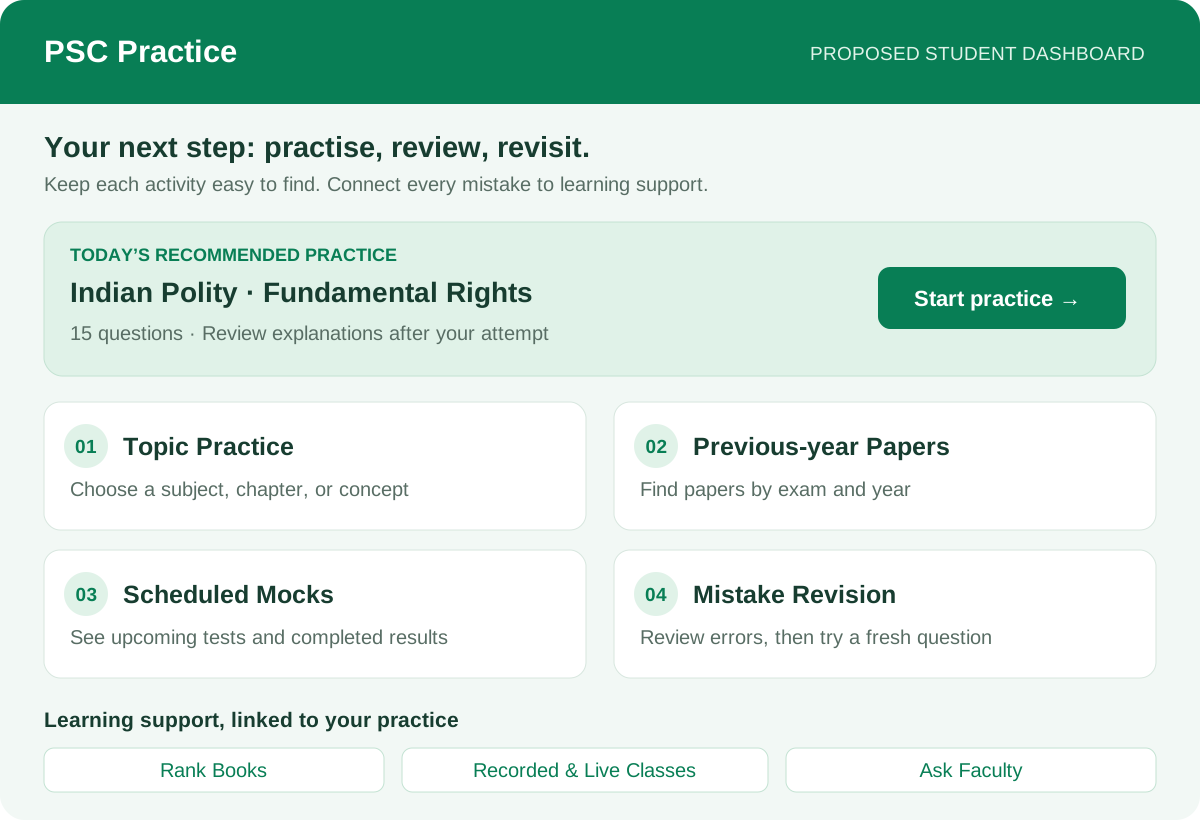
Build the first release around a complete routine: attempt questions, review mistakes, revisit the relevant material, clear doubts, and return for another attempt. Support that routine across Android, iOS, and web.
Why practice should lead your Kerala PSC coaching app
Reading and watching lessons help candidates encounter and understand material. An exam asks them to retrieve that knowledge, distinguish between plausible answers, and work within a time limit.
Our recommendation is to make practice the main organising principle of the app.
The distinction matters. Completing more questions without understanding the mistakes can become another completion counter. Useful practice needs explanations, revision, and enough variety to check whether a candidate understands the concept.
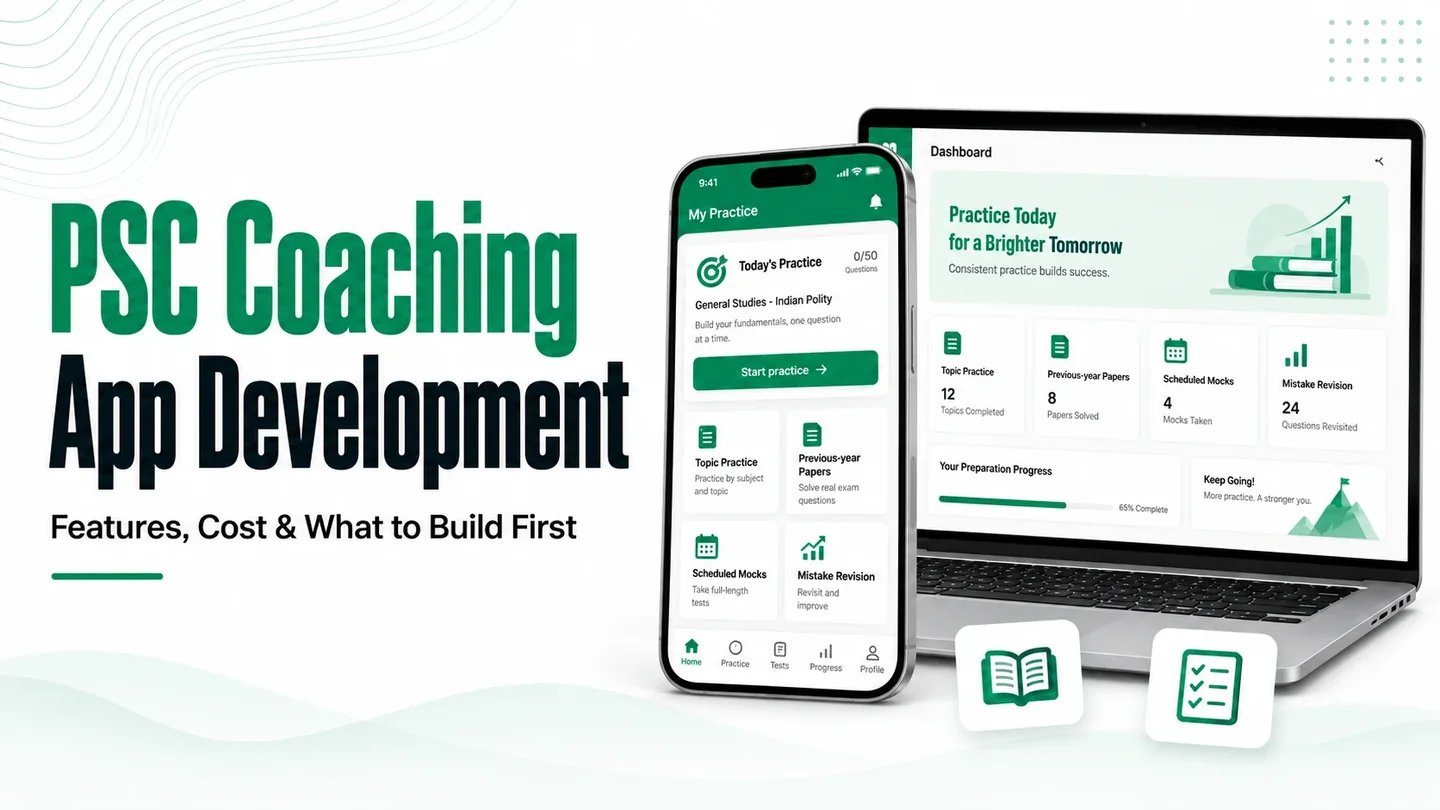
Design the home screen accordingly. Give today's practice, the next scheduled test, and questions due for revision prominent positions. Keep the rank book and classes easy to reach from those activities.
Consider this illustrative journey:
- Attempt a short topic test without opening the answers.
- Review each mistake and read its explanation.
- Open the linked rank-book section or recorded lesson.
- Ask faculty about anything that remains unclear.
- Practise a different question on the same concept.
- Revisit the topic later to check retention.
That is the learning experience you should ask a development team to demonstrate.
Organise practice and test series into distinct sections
A single “Tests” screen becomes difficult to use when it holds every quiz, past paper, revision set, and scheduled exam. Give each activity a clear purpose.
Topic and chapter practice
Let candidates choose an exam, subject, and topic, then attempt a manageable set of questions. Support Malayalam and English content where your courses require both.
Allow students to review explanations after an answer or after the set, depending on the practice mode. Include a way to report an unclear question or a suspected error.
Avoid making a beginner complete an entire chapter before trying any questions. Offer short practice alongside the material, with faculty deciding suitable starting points.
Previous-year question papers
Organise previous-year questions by exam or post, year, subject, and topic. Preserve the original paper as well as allowing its questions to appear in topic practice.
Those are different experiences. A candidate may want to attempt a complete past paper today and revise only its arithmetic questions tomorrow.
Tag each question with its exam, year, subject, and review status. Have faculty check the answer and explanation before publishing it in a practice set.
Daily practice and current affairs
Create a daily section with short mixed-topic practice and dated current-affairs quizzes.
Each current-affairs question should have an explanation, a source, and an editorial review date. Let candidates browse earlier sets instead of losing access when a new quiz appears.
A streak can encourage participation, but measure what happens after the attempt too. Did the candidate review the wrong answers? Did the same mistake recur?
Scheduled test series and full-length mocks
A test series needs its own calendar, enrolment rules, release schedule, and result policy. Candidates should see upcoming papers, completed attempts, and explanations from one place.
Give faculty control over test duration, marks per question, negative marking where required, and how unanswered questions are handled. Show these settings to candidates before they begin.
The result screen should separate correct, incorrect, and unanswered questions, with any deductions clearly explained.
Keep hints, answer explanations, and mentor assistance outside a timed mock until submission. The result should tell the candidate what they could answer independently.
Mistake revision and personalised practice
Give candidates separate views for incorrect, unattempted, and bookmarked questions. These categories shouldn't collapse into one list.
Build revision around concepts as well as repeated questions. After reviewing a mistake, offer a different question on the same topic.
Personalisation can begin with transparent rules: suggest more practice in topics with repeated errors, while retaining coverage of the wider syllabus. Describe a topic as needing more evidence when only a few questions have been attempted.
This doesn't require launching an AI mentor immediately.
Results that guide the next attempt
Show more than a total score. Include topic accuracy, unanswered questions, time spent, and changes across comparable attempts.
If you display a rank, name the comparison group and explain how repeat attempts are treated. A first attempt in a scheduled batch test shouldn't silently compete with somebody's fifth practice attempt.
We have implemented both instructor-created test series and student-created practice exams in Tutor Pro, a learning platform built by Trogon. Instructors select questions from a bank; students can create practice exams from chosen lessons. That distinction informs this recommendation. Documented learning-platform features
For more detail on scoring, question-bank ownership, and rankings, read our guide to online exam and test series software for institutes.
Build rank books your faculty can update
Rank books remain part of the learning experience. Make them useful at the point where a candidate needs an explanation.
For this build, specify a searchable digital rank book organised by subject, chapter, and topic. Connect questions to the relevant passages, and connect each chapter back to its practice sets.
PDFs can remain available as supporting material. Editable chapter content needs its own publishing tools.
Separate content editing from app development
Ask for an administration interface where authorised faculty can:
- Add or revise text, images, examples, and explanations.
- Link a chapter to questions and recorded lessons.
- Preview Malayalam and English content before publication.
- Submit changes for review and publish an approved version.
With that structure, an ordinary chapter correction can be published through the content system. A change to how the app behaves may still require a software release.
Keep a visible last-updated date and a history of revisions. If a chapter is reorganised, existing question links and student bookmarks should still reach the intended material.
Treat answer corrections separately
Updating a paragraph and changing a scored answer have different consequences.
Suppose faculty discover that a question's answer key is wrong. The app should preserve what students originally saw, record the correction, and identify affected attempts.
Your institute then needs a clear policy for recalculating marks and notifying students. Never let yesterday's score change without an explanation.
Build a review step for translated questions too. An English correction may require a corresponding Malayalam update before both versions are republished.
These editorial tools deserve a place in the initial scope. Students will keep using the app after the first batch of content has been uploaded.
Connect classes and doubt clearing to the practice
Recorded and live classes should remain easy to access. Their value increases when a student can reach the relevant teaching directly from a question they couldn't solve.
Recorded lessons with a clear destination
Organise videos by the same subjects and topics used in your rank books and question bank.
From a result explanation, link to the relevant lesson. Where the player supports it, a timestamp can take the candidate to the part that explains the method.
After the lesson, offer a short follow-up set. Keep the student’s earlier attempt visible so they can understand what they are revisiting.
Live classes informed by actual doubts
Use practice results to help faculty plan revision sessions. Repeated errors in one topic can prompt a focused class, followed by a fresh practice set.
Publish the recording under that topic, with a descriptive title and date. Students who miss the session should be able to find it without searching a message group.
Our guide to live class integration for LMS explains how sessions, recordings, and attendance can connect to course records.
Doubt clearing with context
Let a candidate raise a doubt from the question, explanation, or chapter they are viewing. Attach that context automatically.
Faculty should see the attempted answer, the student's question, and earlier replies. Give each doubt a status, an assigned teacher, and a route for follow-up.
A student asking why option B is wrong shouldn't have to type out the entire question again.
Decide who monitors the queue and how often. The app can organise unanswered doubts; the institute still needs people responsible for answering them.
When discussing your build, bring one chapter, its practice questions, and a typical student doubt. Ask the developer to walk through the complete journey before agreeing to separate feature lists.
Launch Android, iOS, and web with shared progress
For this PSC coaching app, plan all three platforms from the beginning.
Use one student account and shared course access. A candidate should be able to practise on a phone and later review the result on a laptop.
Shared progress needs explicit acceptance checks. Bookmarked questions, submitted tests, purchased courses, and resolved doubts should appear consistently across platforms.
A live timed attempt needs stricter rules. Define what happens if someone opens it on another device, loses connectivity, or closes the app. Don't assume every activity should transfer between devices in exactly the same way.
Test Malayalam text, mathematical notation, tables, and question images on actual phones. Include smaller screens and slower connections in the review.
Faculty also need an administration interface suited to longer tasks: editing chapters, importing questions, assembling tests, and reviewing results. Plan that work alongside the student apps.
Our LMS mobile app versus web app guide covers the development and maintenance choices behind these interfaces.
All three platforms belong in the release plan. Each still needs testing, release preparation, and support arrangements.
PSC coaching app development cost: what to budget for
The cost depends on the workflows you commission, the condition of your content, and the services the app needs to connect.
As of September 2026, Trogon custom LMS builds start from ₹3 lakh, with the price increasing according to requirements. This is our general starting price. The complete PSC scope described here needs its own quotation.
Ask for a budget divided into understandable parts.
Our custom LMS development cost guide explains how to separate the build, AMC, integrations and future changes when comparing quotes.
| Budget item | What to clarify |
|---|---|
| Initial development | Android, iOS, web, administration tools, question bank, tests, rank books, classes, and doubt workflows |
| Content preparation | Question entry, chapter formatting, translation, explanations, review, and existing-content imports |
| Recurring infrastructure | Servers, storage, video hosting, live-class services, and OTP usage |
| Payment and distribution costs | Your payment-provider charges, app-store setup, and the purchasing arrangements for each platform |
| Future development | New workflows, integrations, additional features, and later AI work |
The question bank needs its own budget
Software development doesn't automatically include writing explanations, checking answer keys, or converting scanned rank books into structured content.
Assign ownership before work starts. Name the people responsible for question preparation, Malayalam review, and resolving disputed answers.
Give the developer a representative content sample before pricing migration. A clean spreadsheet and a folder of scanned pages require different work.
Recurring costs continue after launch
Trogon charges no LMS licence fee, no per-student platform fee, and no commission on student payments. There is still an AMC covering pass-through infrastructure costs, including servers, video hosting, storage, live-class services, and OTP charges.
Usage can increase those costs. More viewing hours, stored recordings, or simultaneous mock-test attempts may change the infrastructure budget.
Ask for an estimate based on your expected activity and peak test schedule. Registered student count alone doesn't describe the workload.
Your payment provider's own charges remain separate from Trogon's no-commission policy. Also specify what technical support is included and how future feature changes are quoted.
Decide whether a custom build fits
A custom app makes sense when your practice structure, content management, integrations, or ownership requirements justify the investment.
If a standard platform already supports your operation and you need a modest course catalogue quickly, it may be the better starting point.
Our comparison of custom, white-label, and pre-built LMS options explains that decision in more detail.
Add an AI mentor after the core app works
An AI mentor can be useful for a candidate who needs an explanation after faculty have finished for the day. For this launch, place it in the next development phase.
First establish a reviewed question bank, organised rank-book content, reliable test results, and a functioning human doubt-clearing service.
Those become the material and support system the mentor works with.
Start with a focused role: explain practice mistakes using approved content, point to the relevant chapter or lesson, and suggest another practice activity. Let students reach a teacher when the explanation remains unclear.
Require source references and a way to flag questionable answers. Grounding responses in institute material can help constrain the assistant, but it doesn't make every answer correct.
Test Malayalam explanations with faculty before widening access. Numerical solutions need particular attention to intermediate steps.
Keep the mentor unavailable during timed mocks. After submission, it can help the candidate review the result without changing what that attempt measured.
Budget AI usage separately when you introduce it. Estimate the number and type of interactions, and decide whether the first version needs text alone or additional voice and image features.
Read our AI mentor for LMS guide for more on content grounding, running costs, and faculty escalation.
What to build first—and validate before launch
Prioritising development doesn't mean dropping the books, classes, or doubt section. It means building the dependencies in an order that makes the complete app work.
| Stage | Build and validate |
|---|---|
| 1. Content foundation | Exam structure, subjects, topics, question imports, answer review, and editable rank books |
| 2. Practice and testing | Categorised practice, past papers, scheduled series, timed mocks, revision queues, and transparent personalisation rules |
| 3. Learning support | Recorded lessons, live classes, content links, and faculty doubt clearing |
| 4. Student and business flows | Accounts, batches, course access, payments, notifications, and shared progress across all platforms |
| 5. Pilot and release | Faculty training, representative student trials, corrections, and production-load testing |
| Later phase | AI mentor and further improvements justified by actual use |
Test the awkward cases
Before launch, run a real paper with a pilot batch and check more than the final score.
Interrupt the connection during an attempt, then check which answers survive when it returns. Submit at the time limit. Open the same test on two devices and verify that duplicate submissions are handled consistently.
Correct an answer key after results have been released. Check the marks, revision history, and message sent to each affected student.
Check that a successful payment grants the correct course access, and that a failed payment doesn't. Edit a rank-book chapter and follow its existing question links.
Simulate your expected peak number of simultaneous candidates. Make the result part of release acceptance, with the test conditions recorded.
Finally, ask faculty to publish a fresh practice set without the developer's help. If routine publishing still requires a support ticket, the administration experience needs more work.
Can we update rank books after launch?
Yes, if editable chapter content and a review-and-publish interface are included in the build. Keep revision history and preserve links from questions and bookmarks when content changes.
Can we sell test series separately from full courses?
Yes, specify standalone test-series products as well as course bundles. Define access duration, included papers, repeat-attempt rules, and whether explanations remain available after the series ends.
Can we bring our existing questions into the app?
Plan an import assessment using a sample of your actual files. Check question text, answer options, explanations, images, language versions, and topic tags before agreeing on the migration scope.
Should AI be part of the first release?
For this plan, the first release should establish practice, tests, editable materials, classes, and human doubt clearing across Android, iOS, and web. Add AI once there is reliable content and a clear support need.
Start your requirements discussion with one complete learning journey: a candidate gets a question wrong, understands why, finds the right material, clears a doubt, and returns to practise.
For a requirements discussion, explore our LMS development services across Kerala and connect with our team.
Bring a sample question bank, rank-book chapter, course structure, and expected batch sizes. We'll use those to discuss scope and pricing.
Connect on WhatsApp